View generation: progress and cancellation
Long-running view generators — above all ngspice transient simulations — report progress to the web interface and can be aborted from it. This page follows a view request through the pieces involved. The wire protocol itself is specified in Using the web UI and organizing designs, and the API that view generators call is documented under Progress reporting and cancellation.
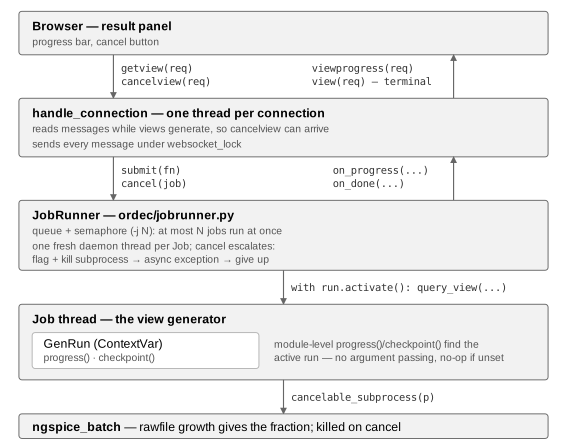
A view request from the browser to ngspice and back
A connection handler is a plain loop reading messages off one WebSocket. It
does not generate views itself: if it did, it would stop reading for the
duration, and a cancelview message would go unseen until the generation it
aborts had already finished. Each getview is instead handed to a job runner
(ordec.jobrunner), which runs it on a thread of its own. That single
constraint shapes the rest: answers no longer come back in request order, so
every request carries an id, and several generators can now run at once, so
their number is bounded by -j.
Before calling the generator, the job thread installs a
GenRun in a ContextVar. Everything below then finds
the run on its own — ngspice_batch calls the module-level
progress() without a handle being threaded through the
call chain, and that same call costs nothing outside the server, where no run
is active. Progress travels back out through the handler’s websocket_lock,
which already serialises sends from other threads.
Cancellation escalates (see ordec.jobrunner.ThreadedJobRunner.cancel()).
Setting the cancel flag makes the generator’s next progress() or
checkpoint() raise, and killing its registered subprocesses unblocks
whatever waits on them — together this covers cooperative generators and
anything sitting in an external tool. A pure-Python loop that never reaches a
checkpoint is interrupted by injecting an asynchronous exception, on CPython.
If neither works, the thread is left running.
Leaving it is deliberate, and the reason is not obvious. A job thread holds
import_lock.read() for the whole generation. Abandoning it as a zombie
would leave RWLock._readers above zero forever: the next rebuild’s
import_lock.write() would block, and since writers take priority, every
later reader queues behind it — the server wedges on the next source edit, long
after the cancellation that caused it. Force-decrementing the count instead
only trades that for a race between the zombie thread and the module purge over
sys.modules. So the ladder gives up visibly rather than quietly: the request
is still answered as cancelled, and a warning notes that a rebuild may stall.
Only a loop inside a C extension gets that far, and nothing short of process
isolation would fix that one.